
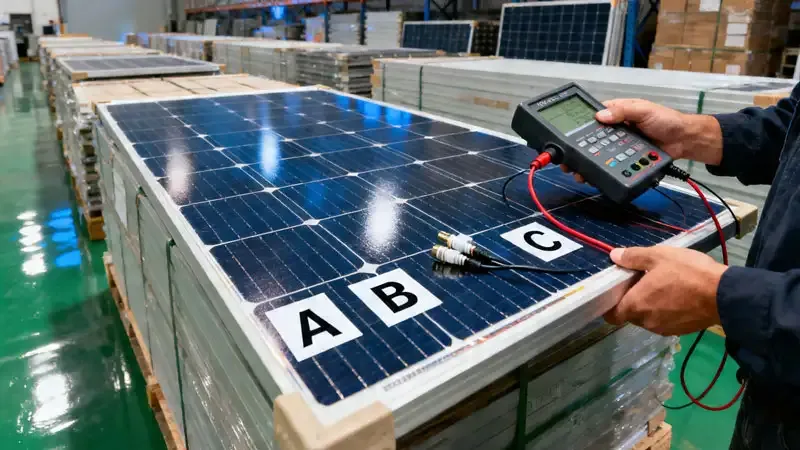
Europe's first wave of utility-scale PV installations is reaching the end of its original contractual life. Combined with early-fleet replacements after hail and PID events, the continent now has a growing supply of used but potentially serviceable modules. At the same time, demand is expanding from off-grid, agrivoltaic, rural electrification, and low-margin commercial projects that cannot justify new-module pricing.
This meeting of supply and demand is creating a second-life solar module market projected to exceed 15 GW annually by 2030. The gating technology for this market — the one that separates marketable units from recyclable scrap — is EL and IV testing.
What "Second-Life" Actually Means
The terminology is still stabilizing, but three categories are emerging:
- Warranty-returned modules. Units pulled from service under warranty, often with identifiable single-defect causes that do not preclude use in less demanding applications.
- Decommissioned modules. Units removed from repowered or re-purposed plants where the original asset owner preferred replacement over refurbishment.
- Surplus and overrun modules. New or barely-used units that never reached final installation, typically from project cancellations or oversupply cycles.
Each category carries different qualification requirements, but all three share the same technical question: what is the residual performance and remaining service life of this module?
Why Visual Inspection Is Not Enough
Many second-life resellers still rely primarily on visual inspection plus a simple open-circuit voltage check. This is inadequate because:
- Microcracks invisible to the naked eye reduce long-term yield by 5-20%
- PID-degraded modules often look cosmetically perfect
- Cold solder joints do not show on the front glass
- Hotspot precursors require EL to detect
- Fill-factor degradation is invisible to voltage-only measurement
Buyers who accept visual-only qualification face a high return rate, failed warranty claims, and reputation damage. Qualifying sellers increasingly demand EL + IV documentation as a condition of sale.
The EL + IV Qualification Protocol
A defensible second-life qualification protocol combines three measurements:
- Visual inspection. Documented photographs of front and rear, junction box, frame and connectors, with damage categorized against a standard rubric.
- EL imaging. Full-module EL image at specified current, interpreted for cell-level defect category and severity.
- IV curve. STC-corrected IV curve from an accurate portable tracer, producing quantitative Pmax, fill factor and Voc figures referenced against original datasheet values.
A grading system then combines these three measurements:
- Grade A. EL with no significant defects, IV within 95% of datasheet, cosmetic condition acceptable. Marketable at 50-70% of new module price.
- Grade B. EL with localized defects not limiting yield, IV within 85-95% of datasheet, minor cosmetic issues. Marketable at 30-50% of new module price for less demanding applications.
- Grade C. EL with significant defects, IV within 70-85% of datasheet. Marketable for off-grid or specialized applications at 15-30% of new module price.
- Scrap. Below Grade C thresholds. Routed to material recovery.
Uniform grading enables price formation across the market, which in turn enables liquidity. Fragmented and inconsistent grading keeps the market inefficient.
Equipment for High-Throughput Qualification
Second-life qualification is volume work. A commercial qualification center processing 500-2000 modules per day needs:
- Inline EL station. Platforms like the SC-MC-W Crack Detection Module handle the tact time, with AI classification reducing manual review load.
- Benchtop PL+EL station. For modules requiring deeper characterization, SC-PLEL-PS provides integrated sequential testing.
- IV tracer workstation. A multi-module IV workflow with calibrated solar simulator or outdoor STC correction.
- Traceability system. Serial number capture, test data archival and grading report generation, integrated with resale inventory.
For operators processing smaller volumes, portable field qualification using SC-DEL-Portable and SC-IV-Portable produces defensible results without fixed capital investment.
The Regulatory Context
Europe's circular-economy regulation is accelerating the second-life market in two directions:
- Producer responsibility requirements push manufacturers to enable reuse pathways, not just recycling.
- End-of-waste criteria being finalized for PV modules will allow qualified second-life units to re-enter the market without waste-regulation friction.
- National procurement programs in several EU member states now prefer second-life modules for publicly funded off-grid and rural electrification projects.
The practical effect: second-life qualification is shifting from an informal resale activity to a regulated certification process, with testing data as the central evidence.
AI and Automated Grading
Manual EL interpretation does not scale to the volumes required for a mature second-life market. Automated defect classification is essential:
- Defect libraries must cover the full range of second-life defect categories, not just factory-new defects
- Grading thresholds require calibration against observed field performance, not just factory QC thresholds
- Uncertainty quantification is more important than in factory QC because buyers need risk-adjusted pricing
Leading qualification centers are moving toward AI-assisted grading with human-in-the-loop review for edge cases.
Common Pitfalls
Three recurring failure modes degrade second-life qualification quality:
- Incomplete environmental correction. Outdoor IV without proper irradiance and temperature sensors produces noisy data that under-qualifies good modules and over-qualifies bad ones.
- Insufficient EL current. Low current produces apparent defects that are just underexposed regions. Full-datasheet-current EL is the standard.
- Inconsistent grading rubrics. Without a written, calibrated rubric, grading drifts between inspectors and across time, eroding buyer trust.
These are solvable with equipment specification, training and documented protocols — but they are routinely neglected.
Commercial Outlook
Second-life solar is transitioning from a niche reseller activity to an institutional market. Procurement buyers, including several European municipal utilities, now issue tenders specifically for second-life modules with defined qualification requirements. Insurance markets are developing residual-life coverage products that price directly from EL + IV data.
Vision Potential's SC-DEL-Portable, SC-IV-Portable, and SC-PLEL-PS platforms are deployed at qualification centers across Europe and Asia, with grading protocols aligned to emerging EU end-of-waste criteria.
Conclusion
The second-life solar market is real, it is growing, and its commercial viability depends on trustworthy qualification data. Operators, resellers and buyers who invest in rigorous EL + IV testing now will be positioned to participate as the market scales — while those who continue to rely on visual inspection and voltage checks will find themselves priced out of serious deals.