
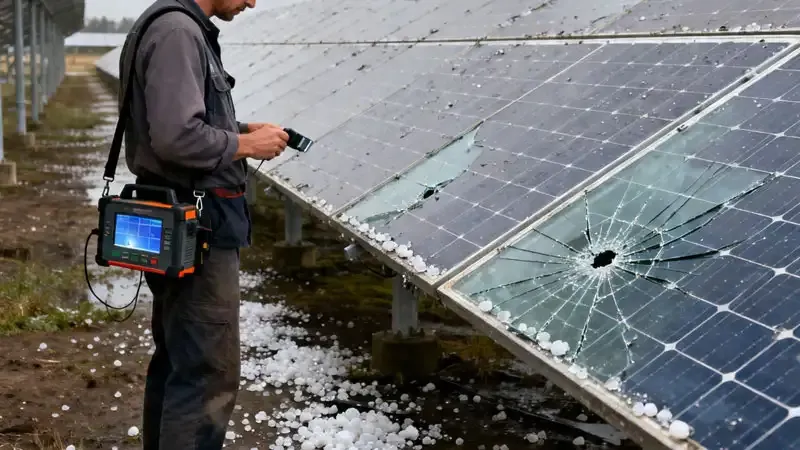
Hail events caused more than USD 2 billion in insured solar plant losses globally in 2024, with 2025 on track to set a new record. For plant operators, the first 30-60 days after a severe hail event are decisive: insurance policies typically require documented damage assessment within that window, and the documentation quality directly determines settlement size.
Yet many operators approach post-hail assessment improvisationally — scrambling for equipment, crew and protocols when they should have been rehearsed long before the storm. This article lays out a field-tested workflow that turns chaotic post-event response into clean, defensible claim documentation.
Why Hail Is Different From Routine Inspection
Routine O&M inspection looks for gradual degradation. Post-hail inspection looks for a punctuated event with distinctive signatures:
- Microcracks invisible to the eye. Hail can crack cells through the glass without visible glass damage. Standard walkthrough inspection misses 60-80% of these.
- Concentrated damage patterns. Damage clusters around physical storm tracks, not randomly across the plant.
- Performance signatures that drift. Microcrack-driven degradation often accelerates over weeks, meaning early post-event assessment understates eventual loss.
- Insurance-grade documentation requirements. Photographs alone rarely suffice; quantitative EL and IV data backed by irradiance records is the industry standard.
Operators who do not anticipate these differences end up either under-documented or over-scoped, both of which cost money.
The 48-Hour Protocol
The first 48 hours after the event set the tone for the entire claim:
- Safety and containment. Before inspection, confirm the plant is electrically safe and that any shattered glass or damaged structures are stabilized.
- Monitoring data snapshot. Export all plant monitoring data from 72 hours before through 72 hours after the event. This baseline is the foundation of every subsequent analysis.
- Drone aerial pass. A standard visual drone sweep using GPS-tagged imagery produces a damage-prevalence map within hours. This drives crew deployment decisions for the weeks that follow.
- Insurance adjuster coordination. Contact the carrier immediately. Most major carriers want direct engagement with the EL/IV testing plan before field work starts, and some require their own witnesses on-site.
- Field crew staging. Pre-contracted EL/IV inspection partners should be on-site within 72 hours. Crews booked after the event often cannot respond before claim deadlines compress.
The Daylight EL Advantage
The single biggest operational improvement in post-hail assessment over the last three years has been daylight EL. Traditional nighttime EL campaigns on a 50 MW plant require four to six working days of night operations. Daylight EL with platforms like the SC-DEL-Portable and SC-DEL-Drone cuts this to one to two days of normal-hour work.
For post-hail assessment, this matters in three ways:
- Claim timeline compression. Faster field work means earlier claim submission, reducing the risk of contractual deadline misses.
- Crew safety. Night work on a damaged plant with fallen debris and unstable mounting is meaningfully riskier than daytime work.
- Better adjuster cooperation. Daytime work allows direct adjuster observation, reducing later dispute on methodology.
The drone option scales well for plants above 20 MW because row-level coverage in one flight window captures all damaged strings without walking every row.
IV as the Loss Quantifier
EL tells you where the damage is. IV tells you how much energy has been lost. For insurance claims, the second question is the one that drives settlement size.
Key IV documentation standards for post-hail claims:
- STC-corrected curves. Raw field measurements are not acceptable. Use paired irradiance and module-backside temperature sensors for correction.
- Voltage range coverage. Modern 1500V plants require IV testers like the SC-IV-Portable that cover the full operating range.
- Pre- and post-event comparison. If baseline IV curves exist from commissioning or annual inspection, comparison against them quantifies the event impact directly. Baseline-free assessments are defensible but weaker.
- Sample size discipline. Document IV on a statistically meaningful fraction of affected strings, not just the most obvious. Adjusters look for sampling that supports population-level loss estimates.
Documentation Package That Gets Settled
An insurance-grade post-hail claim package typically includes:
- Monitoring data export covering event and reference periods
- Meteorological data confirming event severity (hail size, duration, location)
- Aerial damage map with GPS-tagged visual and EL imagery
- Representative EL images showing defect signatures by severity class
- IV curve set on sampled strings, STC-corrected
- Summary report quantifying kWh loss estimate with methodology
- Repair and replacement cost estimate by damage severity tier
Packages that include all seven components settle faster and at higher ratios than packages missing any of them.
Pre-Event Preparation
The operators who settle post-hail claims fastest share a set of pre-event preparations:
- Baseline EL imagery from commissioning. Five-minute-per-module baseline EL is the single most valuable pre-event document.
- Annual EL refresh. Annual EL at a sampling level (10-20% of modules) maintains baseline relevance.
- Pre-contracted inspection partner. A master service agreement with an EL/IV inspection provider activates within 24 hours of notification, bypassing sourcing delays.
- Documented assessment protocol. A written protocol agreed with insurers in advance eliminates methodology disputes during claim review.
Equipment That Makes the Workflow Work
For operators building post-hail response capability, the minimum viable toolkit:
- SC-DEL-Portable daylight EL tester for ground-level inspection
- SC-DEL-Drone daylight EL system for aerial coverage at scale
- SC-IV-Portable 1500V IV curve tracer for performance quantification
- GPS-enabled tablet for real-time module tagging and layout validation
- Tri-proof cases for rapid deployment
For O&M portfolios above 500 MW, owning this equipment outright is typically cheaper than repeated emergency contracting. For smaller portfolios, a pre-contracted partner arrangement is more cost-effective.
Conclusion
Post-hail assessment is a managed process, not an improvisation. The operators who settle cleanly invest in pre-event preparation, deploy daylight EL to compress the field timeline, and produce documentation packages that meet modern insurance standards without friction. The equipment and protocols exist — what separates successful claims from denied ones is the decision to prepare before the storm rather than after it.