
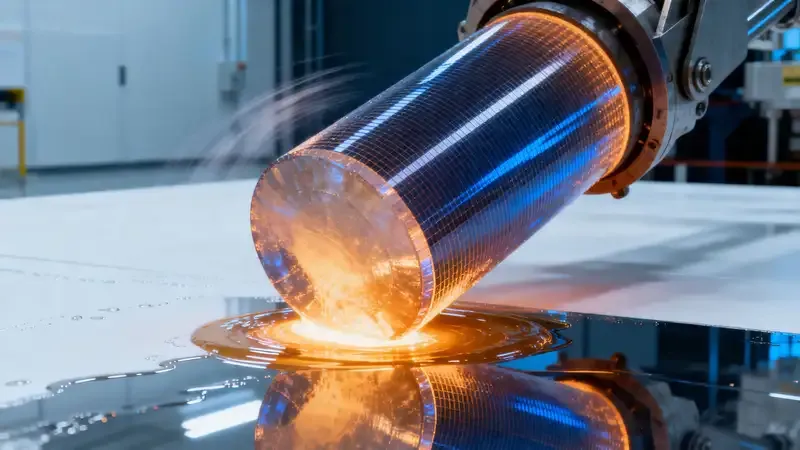
The tandem era has begun. Leading cell manufacturers now ship perovskite-silicon tandem modules with field efficiencies approaching 28% — roughly 20% above single-junction silicon benchmarks. For quality control teams, the change is more than a performance number. Tandem architectures introduce inspection challenges that single-junction experience does not prepare you for.
Why Tandems Are Different
A perovskite-silicon tandem consists of two cells stacked optically:
- Top cell: a wide-bandgap perovskite (typically 1.68 eV) absorbing UV and blue-green light
- Tunnel junction: a thin recombination layer connecting the two sub-cells in series
- Bottom cell: a silicon heterojunction (~1.12 eV) absorbing the remaining visible and near-infrared
Both cells operate in series. The tandem's current is limited by whichever sub-cell produces less, making current matching one of the dominant manufacturing challenges.
The EL Visibility Problem
Conventional EL inspection images emission around 1150 nm — the silicon bandgap. When you apply current to a tandem, each sub-cell emits at its own bandgap:
- Perovskite sub-cell emits around 740–780 nm
- Silicon sub-cell emits around 1150 nm
A conventional InGaAs camera tuned for silicon will see the silicon sub-cell clearly but is blind to perovskite emission. A silicon camera sensitive to 700–900 nm will see the perovskite but not the silicon. Tandem inspection requires dual-band imaging — either two synchronized cameras or a single broadband sensor with switchable spectral filters.
Sub-Cell Defect Signatures
Perovskite sub-cell
Typical defects visible under perovskite-band EL or PL:
- Pinholes in the absorber layer (point dark spots)
- Grain boundary degradation (network patterns)
- Moisture ingress zones (spreading dark fronts)
- Hot-spot scarring from prior exposure
- ETL/HTL delamination at the interface
Silicon sub-cell
Largely familiar from heterojunction inspection experience:
- Microcracks in the silicon wafer
- TCO non-uniformity
- a-Si passivation issues
- Rear contact defects
Tunnel junction
Harder to diagnose — a failing tunnel junction shows up as fill-factor collapse across the whole cell but produces subtle EL signatures: slight global dimming with no localized defect pattern. PL on either sub-cell alone is often normal. Diagnosis requires voltage-sweep EL or IV characterization.
Current Matching Visualization
Because the sub-cells are series-connected, the less-productive cell limits the tandem current. Current mismatch shows up differently in perovskite vs silicon EL imaging:
- Under low-current EL, both sub-cells emit weakly
- Under near-operating EL, the limiting cell is bright; the non-limiting cell is moderate
- Under over-current EL, the limiting cell becomes bright and saturated; the non-limiting cell dims
This reversal pattern is diagnostic. A well-tuned tandem shows matched brightness across both sub-cells at operating current. A poorly tuned tandem shows dramatic asymmetry.
Environmental Handling Requirements
Perovskite is sensitive to water, oxygen, UV, and heat. Inspection equipment must accommodate:
- Temperature control: Sub-30 °C during measurement to prevent degradation
- Inert or dry atmosphere: Nitrogen purging for encapsulated cells; stricter protocols for unencapsulated test cells
- Rapid measurement: Minimize cumulative UV exposure from any laser PL excitation
- Minimal current injection: High-current EL can drive ion migration and accelerate degradation
Labs running prototype inspection routinely report degradation traces on unencapsulated samples after repeated testing. Production encapsulated cells are more robust but still warrant conservative measurement protocols.
Pilot-Line Instrumentation
Vision Potential's SC-PLEL-PS integrated EL+PL platform has been validated on both single-junction and tandem perovskite-silicon cells, including the critical dual-band spectral capability. Sub-cell-specific recipes allow separate imaging of perovskite and silicon bands in a single measurement cycle.
Pilot-line operators specifying tandem inspection equipment should verify:
- Spectral response across 700–1700 nm or dual synchronized cameras
- Environmental controls meeting perovskite stability requirements
- Recipe support for per-sub-cell imaging
- AI classifier pre-trained on tandem defect libraries or a supported workflow for rapid custom training
- Upgrade path from single-junction to tandem without full equipment replacement
AI Classification for Tandem Defects
Existing single-junction defect classifiers do not transfer to tandem. The defect taxonomy is larger (perovskite-specific categories), the image data has two spectral channels rather than one, and correlation between channels carries diagnostic weight.
Modern tandem classifiers are being built on multi-modal transformer architectures that jointly process both spectral channels and learn cross-channel correlations. Early deployments report detection rates above 96% on production-relevant tandem defect categories, but these systems still require frequent retraining as tandem process technologies evolve.
Looking Ahead
The tandem-cell transition will play out over 3–7 years as manufacturers work through pilot-production learning curves. For quality control equipment providers, the critical capability is flexibility: hardware and software that today handles single-junction PERC, TOPCon, HJT, xBC, and can extend to tandem imaging without capital replacement.
Fabs making inspection capital decisions today should ask explicitly about tandem readiness. Equipment that locks into today's single-junction assumptions will be replaced within its normal depreciation period — a costly mistake that is entirely avoidable with appropriate forward specification.