
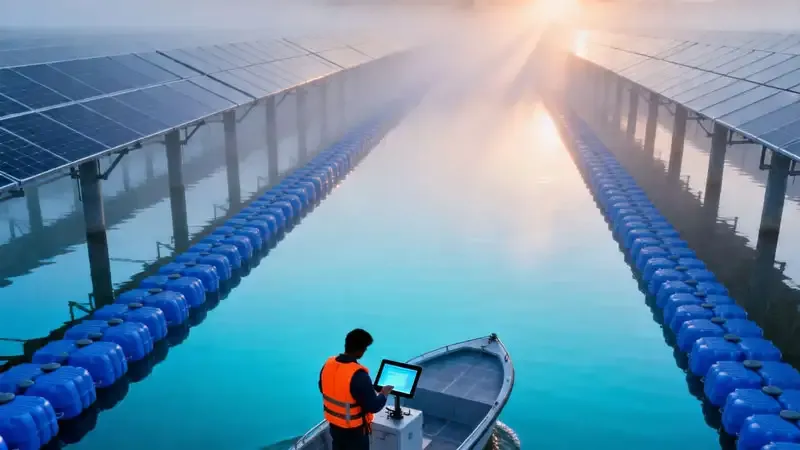
Floating photovoltaic (FPV) plants are moving from pilot scale to gigawatt rollouts. Europe added more than 1 GW of FPV capacity in 2025 alone, with projects live in the Netherlands, France, Portugal and Italy. Asia-Pacific continues to lead overall deployment. Yet most solar O&M teams still approach FPV inspection with toolkits and procedures copied from ground-mount plants — and it shows, in the form of missed defects, damaged equipment and longer downtime.
This guide walks through the practical differences that matter when inspecting a floating solar plant.
Why FPV Inspection Is Not Just "Ground-Mount on Pontoons"
The physics are identical: EL, PL and IV all work exactly the same on a module that happens to be floating. What changes is everything around the module.
- Access geometry. You walk rows on dry land. On FPV, you navigate between pontoons on foot, by boat, or by drone — none of which are as forgiving.
- Environmental exposure. Humidity is near-saturating for much of the year. Marine or brackish sites add salt spray. Dew persists well after sunrise.
- Power and cabling. Mains power at a portable generator location is rarely available. Battery-operated instruments and cordless workflows move from "nice to have" to "essential."
- Safety envelope. Walking platforms are often narrow, slippery and unstable. Tools dropped in the water are not recoverable.
A fleet of ground-mount inspection tools dropped onto an FPV site will produce a bad day for operators.
What Fails First
Three defect categories are consistently over-represented on FPV installations compared with their ground-mount peers:
- Moisture ingress. Persistent high humidity accelerates backsheet degradation and junction-box failure. EL imaging reveals the resulting cell-level darkening pattern before monitoring data catches up.
- Corrosion-driven resistance. Salt and moisture at connectors raise series resistance. IV curves show the characteristic fill-factor erosion.
- PID and shunt paths. Humidity amplifies Potential-Induced Degradation risk. Daylight EL screening is the fastest way to confirm.
Treating these as "eventually likely" instead of "expect within 24 months" is the main planning mistake for FPV asset owners.
Equipment Selection for FPV Work
Portability, battery endurance and ruggedness all step up one notch compared with ground-mount inspection.
- Daylight EL. Nighttime EL on water is impractical and unsafe. The SC-DEL-Portable platform enables shoulder-carried daylight EL with no generator or cabling, turning a full-day campaign into a morning of single-operator work.
- Drone EL. For mid and large FPV plants, drone-based daylight EL (SC-DEL-Drone) removes the need to walk the platform at all. Row-level coverage in one flight window replaces days of boat-assisted ground work.
- Portable IV. A battery-powered 1500V-capable IV tracer like the SC-IV-Portable lets crews verify performance losses and document warranty claims without running cabling back to shore.
- Protective packaging. Tri-proof cases (IP65 minimum), padded straps, and lanyards for every handheld become standard, not optional.
Field Workflow That Works
A well-run FPV inspection day follows this sequence:
- Pre-visit monitoring review. Identify suspect strings from inverter and weather data. FPV string counts are typically higher per MW than ground-mount, so pre-filtering is essential.
- Drone aerial pass. A single drone flight with SC-DEL-Drone produces a full-plant thermal and EL panorama. This sets the priority list for foot inspection.
- Targeted foot inspection. Only platforms flagged by the drone pass get a pontoon walk with SC-DEL-Portable and SC-IV-Portable.
- Sample-based IV verification. For warranty documentation, spot-check suspect strings with STC-corrected IV curves.
- Same-day report. FPV sites are often far from operator offices. On-site report generation reduces follow-up trips.
This workflow typically cuts FPV inspection day-count in half compared with boat-only or generator-dependent methods.
Safety and Regulatory Notes
- Marine sites may require additional permitting before instruments enter the water.
- Lithium battery handling on water falls under different safety rules in some jurisdictions — check before shipping equipment.
- Two-person minimum crews are the norm for any above-water work, even for short inspections.
- All electrical equipment must maintain bonding-to-pontoon protocols to prevent stray-current hazards.
Data Considerations
FPV installations generate more variable IV data than ground-mount because water-cooling effects shift the operating temperature of modules. STC correction with paired irradiance and module-backside temperature sensors becomes critical; correction using ambient air temperature produces biased results.
Archiving EL images with precise module IDs and GPS tags is essential because pontoon repositioning during storms can scramble assumed layouts. Many FPV O&M teams now require photo documentation of every suspect module from two distinct angles.
Commercial Outlook
Europe's FPV pipeline for 2026-2027 is dominated by projects in sub-100 MW size, often linked to industrial water reservoirs or hydropower basins. Asia-Pacific continues to host the largest single projects. In both cases, asset owners are increasingly demanding annual inspection coverage backed by quantitative EL and IV data rather than visual walkthroughs — a shift that elevates the role of specialized, portable, battery-operated instruments.
Vision Potential's portable daylight EL and IV platforms are validated for marine and freshwater FPV environments, with reference deployments across European reservoirs and Southeast Asian aquaculture sites.
Conclusion
Floating solar is not a niche anymore, and its inspection needs deserve planning beyond adapted ground-mount procedures. Operators who invest in FPV-appropriate portable tooling and workflows now will carry lower defect-discovery lag, lower safety incident rates, and stronger warranty defense than peers who treat the water as an incidental detail.