
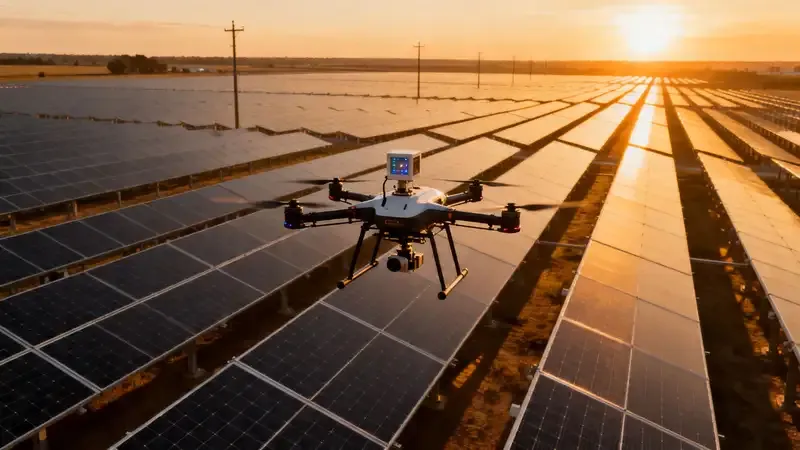
The economics of solar plant inspection have inverted. Five years ago, manual nighttime EL inspection was the only practical option. Today, daylight drone EL combined with AI-powered defect classification has become operationally superior across nearly every dimension that matters.
The Old Way: Why Manual Nighttime Inspection Doesn't Scale
Inspecting a 100MW solar plant with approximately 300,000 modules using two-person night shift teams runs into thousands of person-hours. Add the safety burden of nighttime field work, fatigue-driven errors, and the impossibility of inspecting all modules in reasonable timeframes, and limitations become obvious. Most operators sampled only 5-10 percent of modules.
The Daylight EL Breakthrough
Daylight EL eliminates the nighttime constraint. The technology uses InGaAs sensors with patented filtering and lock-in amplification to extract faint EL signals from the bright solar background. Modern systems achieve 50 micrometer crack detection sensitivity under full sun.
The Vision Potential SC-DEL-Drone system mounts daylight EL detection on a DJI Matrice 400 platform with:
- 55-minute flight time per battery
- 0.1mm/pixel imaging resolution
- 5 million IR pixels per capture
- Operating temperature -30°C to 50°C
- Integrated GPS coordinates for every defect
A single drone covers areas that previously required multi-week ground crews. Field tests regularly show 10x throughput improvements with no sacrifice in defect detection sensitivity.
AI Classification Closes the Loop
Modern deep learning models trained on labeled photovoltaic defect databases now classify defect types — microcracks, broken cells, hot spots, PID, soldering defects, finger interruption — with accuracy matching trained human technicians at processing speeds measured in milliseconds per image.
The practical workflow: flight planning, autonomous capture, AI processing, GIS-mapped report generation, and maintenance dispatch. A 100MW plant can be fully inspected, processed, and reported within a single working week.
Economic Comparison
For a 100MW utility-scale plant, comparing manual nighttime EL versus drone EL plus AI:
- Inspection cycle: 4-6 weeks vs 3-5 days
- Personnel: 8-12 vs 2-3
- Coverage: 5-10 percent sampled vs 100 percent complete
- Defect detection rate: 20-30 percent vs 85-95 percent
- Annual cost: 200K-400K USD vs 50K-100K USD
The cost gap widens further at larger plant sizes.
Looking Ahead
Drone EL plus AI inspection will become the default approach for utility-scale solar plants by 2027-2028. For operators planning inspection programs for the 2026-2027 maintenance cycles, evaluating drone EL plus AI capabilities should be a priority. The technology has crossed the threshold from emerging to operational; the question now is execution speed, not feasibility.