
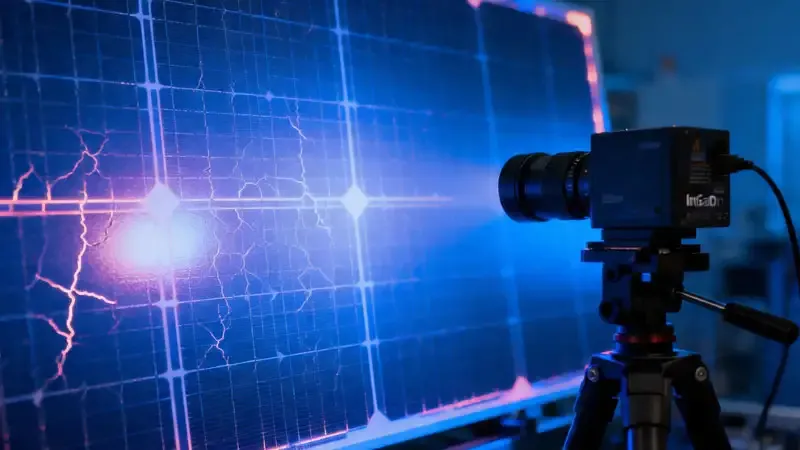
Bifacial modules crossed the 50% share threshold for utility-scale shipments in 2024 and have not looked back. TOPCon, HJT and emerging xBC architectures ship almost exclusively in bifacial form today. Yet many module fabs and third-party test labs continue to EL-image only the front face, a habit carried over from PERC-era monofacial lines. This leaves a meaningful share of defects invisible until they become warranty claims.
This article lays out why rear-side EL inspection is now non-negotiable and how to implement it efficiently.
Why Front-Only EL Is No Longer Enough
On a monofacial PERC module, the rear surface is opaque and carries no functional optical role. A single front-side EL image captures essentially all useful information about cell-level defects.
Bifacial modules break this assumption in three ways:
- Light reaches the rear in service. Any defect that degrades rear-side response directly reduces field energy yield, often by 5-15% of total output depending on albedo conditions.
- Rear-side metallization introduces new defect categories. Broken fingers, cold solder joints and contact misalignment on the rear are invisible from the front.
- Transparent backsheets and glass-glass lamination expose rear cell defects optically. Quality control that skips rear imaging leaves these visible-to-customer defects undetected in QC.
The combined effect: front-only EL can pass a module that will underperform at 40-60% of its bifaciality gain, while also presenting a visible cosmetic flaw on the back glass.
What Rear-Side EL Reveals
Rear-side EL on bifacial modules surfaces defect classes that remain essentially hidden from front imaging:
- Rear busbar and ribbon cold solder. These modify fill factor under bifacial illumination but not under standard STC front-only testing.
- Rear finger damage. Far more common than front-side finger damage on many stringer designs.
- Rear passivation non-uniformity. Critical for TOPCon and HJT, where the rear passivation stack carries significant efficiency leverage.
- Interconnect polarity errors. Bifacial modules with reversed rear ribbons still pass initial electrical tests but fail under bifacial illumination.
- Edge sealing and junction box backside defects. Thermal cycling failures often originate at these points.
Equally important, the image quality of rear-side EL on transparent-backed modules is often excellent because there is no encapsulant obstruction between the camera and the cell.
Camera and Current Considerations
Rear-side imaging brings practical requirements that differ from front imaging:
- Camera spectral response. Rear-side luminescence passes through transparent backsheet or glass with slightly different spectral filtering than the front. InGaAs cameras with broad 900-1700nm response preserve information that narrow-band cameras may lose.
- Current settings. Bifacial cells often require adjusted injection currents for rear-side imaging because the rear contact impedance differs from the front.
- Handling and orientation. Test stations must accept modules in both orientations without damaging the front glass. Vacuum tables and padded frames are standard.
- Double exposure workflow. Sequential front-then-rear imaging captures a complete defect fingerprint. Modern stations like the SC-MC-W Crack Detection Module support this workflow with under-two-minute total tact time per module.
For lab-scale characterization, the SC-PLEL-PS Integrated Tester combines EL and PL in a single pass, with rear-side imaging available as a standard configuration.
Inline Implementation
Production lines that have not yet upgraded to dual-side EL typically face one of these situations:
- Existing single-side EL station with a fixed camera orientation — either add a second station downstream or upgrade to a flipping fixture.
- Pre-lamination EL only — extend to post-lamination dual-side verification for utility-scale lines where warranty liability dominates.
- Visual-only QC for rear side — upgrade to EL because visual inspection misses fine metallization defects.
Tact-time budgeting is the main engineering constraint. A well-designed dual-side EL station can complete both images in 8-12 seconds, compatible with 6000-module-per-day line rates.
AI Classification Considerations
Defect libraries trained on front-side PERC images do not translate to rear-side TOPCon or HJT imaging. Practical deployments require:
- Separate AI models for front and rear inference, each trained on the relevant cell technology.
- Defect categories expanded to include rear-specific failure modes (rear busbar cold solder, rear finger loss, polarity errors).
- Continuous retraining pipelines because bifacial module designs evolve faster than monofacial ones.
Platforms that support configurable AI models are meaningfully easier to operate across multiple bifacial product lines than those with fixed classifiers.
Financial Case
The return on dual-side EL investment is straightforward:
- Bifacial yield loss from undetected rear defects averages 3-8% on affected modules, based on field studies.
- For a 600 MW-per-year module fab, even a 1% improvement in rear-defect catch rate translates into multi-million-dollar annual warranty and rework savings.
- The capital cost of adding rear-side EL to an existing line is typically recovered within the first twelve months of production.
Audit Expectations
Increasingly, procurement contracts for utility-scale bifacial modules require documented dual-side EL as part of the factory acceptance protocol. Projects financed through major European banks often require third-party witnessed EL imaging from both sides. Fabs that cannot produce rear-side EL reports on demand face either lost contracts or painful retrofits.
Conclusion
Bifacial is now the default for utility-scale solar. Inspection that assumes monofacial geometry is inspection that misses a significant share of real defects. Upgrading to dual-side EL — in the factory, in third-party test labs, and in field commissioning — is a prerequisite for defensible quality claims on any modern PV project.
Vision Potential's SC-MC-W and SC-PLEL-PS platforms support dual-side bifacial imaging out of the box, with AI classification models validated across TOPCon, HJT and emerging xBC architectures.