
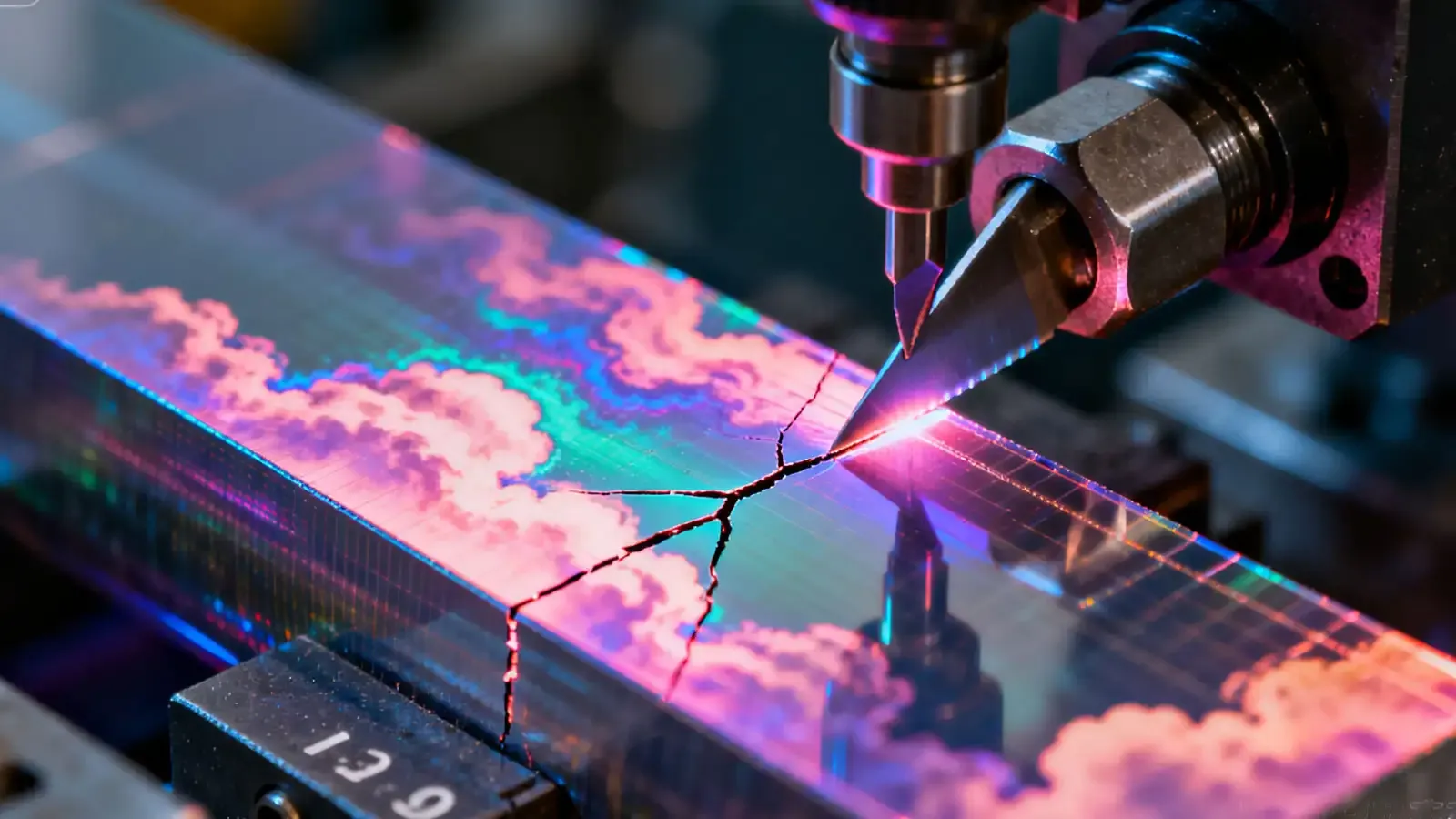
24.16 MP IP-Rated Case: Engineering Philosophy of Off-Grid SC-EL-Portable
Engineering a portable EL system is much harder than a lab EL bench. Lab EL controls temperature, humidity, lighting; portable EL must operate alone at -20 °C on the Gobi, +45 °C in deserts, and through rainstorms. SC-EL-Portable is MVCreate's flagship for nighttime off-grid inspection — 24.16 MP silicon camera + Wi-Fi control + IP65 trolley case. This article goes through each choice and answers "why was this set this way?"
1. Why exactly 24.16 megapixels
Industry portable ELs use 8 MP, 12 MP, or 20 MP cameras. We chose 24.16. Where does that number come from?
For a standard 182 mm mono-PERC cell with 10 busbars:
- Minimum identifiable microcrack width across a busbar ≈ 25 μm;
- Cell width 182 mm; resolving 25 μm needs ≥ 7,280 px horizontal resolution;
- Add ±20% field-of-view headroom → horizontal resolution should be ≥ 8,736 px.
A 24.16 MP camera typically delivers 6,048 × 4,032:
| Sensor | Per-cell field | Microcrack limit |
|---|---|---|
| 8 MP (3856×2764) | 1 cell | 50 μm |
| 12 MP (4096×3000) | 1 cell | 40 μm |
| 20 MP (5184×3888) | 1 cell | 30 μm |
| 24.16 MP (6048×4032) | 1 cell + 1/4 of neighbor | 22 μm |
22 μm is close to the physical limit of microcrack detection (set by silicon grain structure). Going higher pays diminishing returns while raising cost by 60%+. So 24.16 is today's optimum.
2. Why wireless control is non-negotiable
Customers often ask, "Why not just use a cable?" Three reasons:
- Worksite geometry: panel-to-panel gaps are 30–50 cm; the operator squats below alignng, shooting, and reviewing — any cable becomes a tripping hazard;
- Team workflow: typically 1 person aligning + 1 reviewing on the screen + 1 logging — screen and camera must be separable to parallelize the workflow;
- Avoiding cable damage: small camera-pose tweaks can yank cables; repeated tugs ruin connector waterproofing.
Wireless solution: the camera embeds an 802.11ac module bound to a +30 dBm industrial AP shipped with the kit — effective control range 50 m. A tablet or phone connects directly. Control latency <100 ms; image transfer ~3 s/frame.
3. Why an IP65 trolley case
The biggest field killer of portable EL is not "drops" — it's dust, rain, temperature swing. We have field-failure data:
| Failure mode | Share | Typical scenario |
|---|---|---|
| Sand/dust ingress (camera/connector) | 38% | NW China, Inner Mongolia Gobi |
| Rain / condensation ingress | 27% | Southern summer, offshore |
| Lens fog from temperature swing | 22% | Plateau, dawn shift |
| Physical impact | 13% | In transit |
SC-EL-Portable's tri-protection design addresses each:
- Case-level IP65: the whole unit lives inside an IP65 trolley case; just open the lid to operate;
- Camera-level IP54: camera body is independently IP54 — safe even when removed for short use;
- Anti-condensation: desiccant chamber + temperature-balancing vent prevent condensation;
- Impact: integrated EVA foam tolerates 1.2 m drop without harm.
4. SC-EL-Portable vs SC-DEL-Portable
Customers often hesitate between these two. The cheat sheet:
| Dimension | SC-EL-Portable | SC-DEL-Portable |
|---|---|---|
| Operating window | Night only | Day + night |
| Per-cell image quality | 22 μm | 35 μm |
| Total weight | 8 kg (with case) | 5 kg |
| Modules per night | 800–1,000 | 600–800 |
| Suitable scale | 5–50 MW | <5 MW + rooftops |
| Environment | Off-grid, deserts, offshore | Rooftops, near urban |
| Price tier | Mid | Mid–High |
Quick rule: highest image quality + off-grid → SC-EL-Portable; lightweight + daytime → SC-DEL-Portable.
5. Customer fit
Strongest performance scenarios:
- NW utility-scale plants: 50–200 MW per site, mandatory annual full EL, far from O&M base;
- Offshore floating PV: salt-spray demands extreme corrosion resistance;
- Research institutes: need top image quality for defect-morphology studies;
- Third-party assessors: cross-site work requires the most robust environmental tolerance.
6. A blind-test datapoint
At an 80 MW plant in Inner Mongolia we ran a blind test — SC-EL-Portable images and 12 MP competitor images of the same panels reviewed by 5 senior O&M engineers:
- 8 MP image: 12 defects identified
- 12 MP image: 18 defects identified
- 24.16 MP SC-EL-Portable image: 31 defects identified
Subsequent destructive analysis confirmed 33 real defects. Detection rate: SC-EL-Portable 94%, 12 MP 55%, 8 MP 36%.
For demos or a head-to-head comparison, contact MVCreate at +86 159-5048-9233.
Originally published by Vision Potential (Nanjing MVCreate Intelligent Technology Co., Ltd.). Reproductions must credit the source.